Lotus Esprit GT3 Buyer’s Guide: History, Driving Feel and What to Check
Mention the Lotus Esprit and most people picture the V8 flagships or the white wedge that drove off a jetty and into film history. The Esprit GT3 sits in neither spotlight, and that is precisely what makes it interesting. Built in tiny numbers towards the end of the Esprit’s long production run, the GT3 took the model back to first principles: less weight, less excess, and more of the steering feel Lotus built its name on.
This guide covers where the GT3 fits in the Esprit story, its key specifications, how it drives against the V8, what to check before buying one, and why collectors in Australia are starting to look twice at what may be the most underrated Esprit of them all.
Where the GT3 fits in the Esprit story
Few silhouettes from the 1970s aged as well as the Esprit’s. Penned as a dramatic origami wedge, it became a poster icon almost overnight, and the softened, more muscular redesign that carried it through the 1990s kept it looking exotic long after its rivals dated. The Esprit enjoyed a remarkable production run of nearly three decades, from 1976 to 2004.
Screen fame helped. An earlier Esprit’s turn as the submarine car in The Spy Who Loved Me (1977) fixed the shape permanently in popular culture, and further appearances in For Your Eyes Only and Pretty Woman kept the badge in the public eye. None of those cars were GT3s, but the GT3 shares the same lineage. Beneath the image, the Esprit was always a mid-engined, low-slung British sports car built around the idea that weight is the enemy.
The entry-level Esprit that became the driver’s Esprit
By the late 1990s the range was crowned by the twin-turbocharged Esprit V8, but Lotus also offered something quieter and, many enthusiasts would argue, truer to the brand. The GT3 was conceived as an entry-level, no-frills Esprit intended to bring the marque within reach of newcomers to the supercar world. It paired a turbocharged 2.0-litre four-cylinder with a deliberately pared-back specification, trimming weight and complexity rather than adding it.
Ironically, by stripping things back, Lotus created what many marque specialists consider the best-driving Esprit of all. It quickly earned a reputation as the “driver’s Esprit”, and as one of the final iterations before the model bowed out, it is often described as the swan song of the analogue four-cylinder Esprit.
Lotus Esprit GT3 specifications
- Engine: Mid-mounted 2.0-litre (1,973 cc) 16-valve turbocharged, charge-cooled inline-four (Lotus Type 920)
- Power: 240 bhp at 6,250 rpm
- Torque: 216 lb-ft at 3,750 rpm
- Acceleration: 0–100 km/h in around 5 seconds (0–60 mph approximately 5.1 seconds)
- Top speed: Around 260 km/h (163 mph)
- Transmission: Five-speed manual transaxle, rear-wheel drive
- Chassis: Steel backbone with lightweight composite bodywork, two seats
- Weight: Roughly 1,230 kg
- Production: 196 built worldwide
On paper, a 2.0-litre four might seem modest next to a big Australian V8. In practice the numbers tell only half the story. At around 1,230 kg, the GT3 lives by Colin Chapman’s founding philosophy: “simplify, then add lightness”. The result is a car that feels faster, sharper and more alive than its displacement suggests.
How the GT3 drives compared with the V8
This is where the GT3 earns its reputation. The turbocharged four spins up eagerly, the mid-engined balance is excellent, and the feedback through the wheel is the kind modern electrically assisted steering has largely engineered away. Slip into the snug cockpit, with its race-inspired instrument layout and classic wooden Lotus gear knob, and the car’s purpose is obvious before you turn a wheel.
On a winding road the GT3 flows through corners with a precision heavier machinery cannot match, and every input is met with an immediate, honest response. The gearbox is a proper manual: mechanical and rewarding. It is a car that rewards a driver rather than flattering one, and it is genuinely involving at legal speeds, which matters on Australian roads.
Four cylinders against eight
The V8 Esprit has more power and will out-accelerate the GT3 in a straight line. But the four-cylinder GT3 is about 150 kg lighter, and that lower weight gives it a more agile, balanced feel. Many enthusiasts find the GT3 more engaging on a twisty road precisely because it trades outright firepower for balance, steering feel and chassis communication. It is not about brute force; it is about a car working with the driver rather than insulating them from the road.
What to check when buying a Lotus Esprit GT3
Because the GT3 is so rare, specialised servicing history in Australia is thin compared with more common European sports cars. A pre-purchase inspection by a Lotus-experienced technician is strongly recommended, and the following areas deserve particular attention:
- Cambelt and water pump history: These are interval-sensitive components, and a missed service can be catastrophic. Turbocharged Lotus engines respond well to consistent care, so look for a documented maintenance record.
- Cooling system and turbo health: The mid-engine layout places thermal demands on components that can suffer with age and infrequent use. Confirm the charge-cooling system and turbocharger are in good order, with no signs of overheating.
- Chassis and body: Inspect the steel backbone chassis for corrosion and any evidence of previous accident damage or repairs, and check the composite body for the quality of past repairs and paint.
- Electrical systems: Late-1990s Lotus wiring can suffer age-related issues, particularly in hotter climates.
- Originality: The correct factory colour, trim and specification support long-term value, especially on a rare-colour car.
- Documentation and provenance: With only 196 built, history matters enormously. Original service books and import compliance paperwork materially affect resale value in Australia.
Right-hand drive and importing
The GT3 was built in right-hand drive, so an example can be enjoyed on Australian roads as intended without conversion questions hanging over its history. Very few GT3s ever reached Australia, so for most buyers importing one is the realistic route to ownership, which brings shipping, compliance and registration into the picture alongside the mechanical checks above.
Rarity, collectability and values in Australia
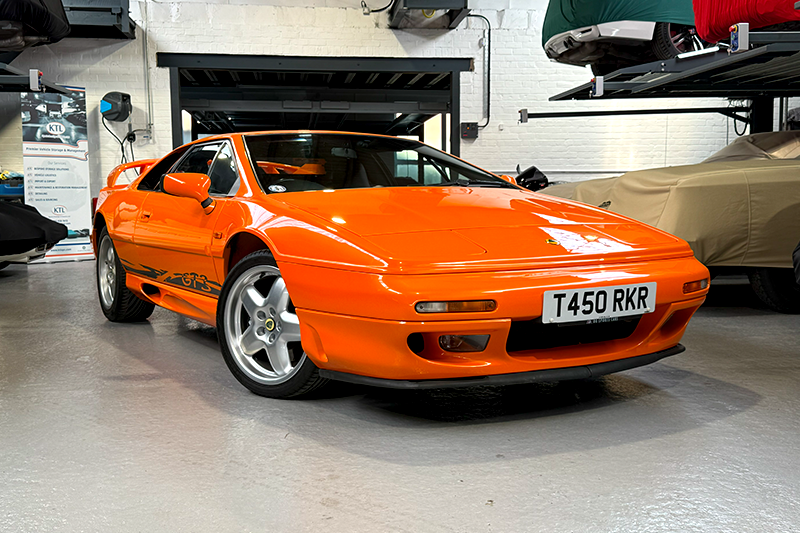
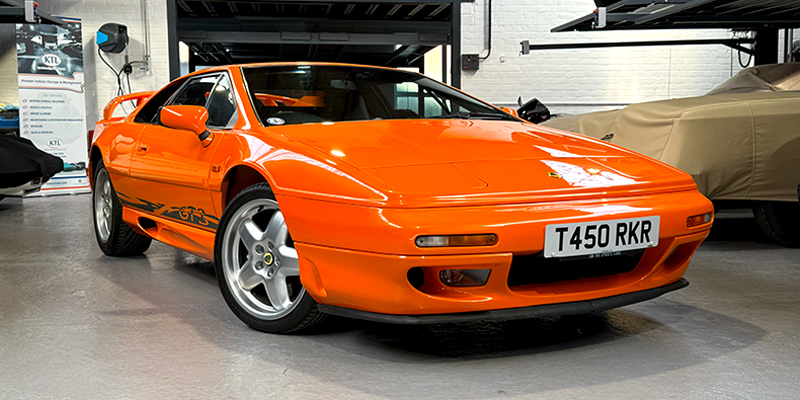
Production figures tell the story quickly. The GT3 accounts for just 196 cars, a fraction of total Esprit production, and survivors are scattered thinly across the world, most of them in the UK and Europe. Fewer than five GT3s are believed to be in Australia. Only two were finished in orange, a colour distinction that is not cosmetic trivia: on a sub-200 production run it has a direct effect on provenance and long-term interest. We are fortunate to have one of those two, the orange Esprit GT3 in our collection, a right-hand drive manual car showing around 88,000 miles.
The GT3’s appeal to collectors rests on several converging factors. Late-1990s analogue British sports cars are attracting renewed interest from enthusiasts who want genuine provenance and mechanical simplicity, and who look beyond the usual Ferraris and Porsches. The Esprit’s film associations broaden its recognition beyond pure Lotus enthusiasts, and values for well-documented examples have been reported as trending upward. As the market increasingly favours manual, driver-focused cars, the lightest Esprit has quietly moved from footnote to find.
Rarity alone never made a car worth owning. Rarity attached to a genuinely loved driver’s car is a different proposition, and that is the GT3’s real strength.
Tony’s view: the analogue alternative
Tony rates the GT3 as one of the purest Esprits: lighter, simpler and more focused than the V8, and still overlooked by buyers who go straight to a Ferrari or Porsche. Few were made, so a well-documented example is worth waiting for.
The 1999 Lotus Esprit GT3 in the collection is one of only a handful in Australia, and you can watch Tony’s video of it. If you are after a particular Esprit, Tony can search for one here or overseas and handle the import.
Keep reading: What Is the Ariel Nomad? · The Ferrari 348 TS · The Collector’s Eye: Deciphering Authenticity
Watch the video
Lotus Esprit GT3
Frequently asked questions
How many Lotus Esprit GT3s were made?
Just 196 Esprit GT3s were produced worldwide, making it one of the rarest Esprit variants. Only two were finished in orange, and fewer than five GT3s are believed to be in Australia.
What engine does the Esprit GT3 use?
The GT3 uses a mid-mounted 2.0-litre turbocharged, charge-cooled 16-valve inline-four, the Lotus Type 920, producing 240 bhp and 216 lb-ft. It drives the rear wheels through a five-speed manual transaxle.
How does the GT3 compare with the Esprit V8?
The twin-turbocharged V8 has more power and is quicker in a straight line, but the GT3 is about 150 kg lighter. Many enthusiasts consider the GT3 the purer, more connected drive, with better balance and steering feel on a winding road.
Why is the GT3 called the driver’s Esprit?
Conceived as a lightweight, no-frills entry model, the GT3 ended up delivering exceptional balance, steering feel and responsiveness. It embodies Colin Chapman’s “simplify, then add lightness” philosophy more clearly than almost any other Esprit.
What should you check before buying an Esprit GT3?
Prioritise cambelt and water pump history, cooling system and turbocharger health, the condition of the steel backbone chassis and composite body, electrical systems, originality of specification and documented provenance. A pre-purchase inspection by a Lotus-experienced technician is a sensible step.
Was the GT3 the Esprit used in James Bond films?
No. The submarine car in The Spy Who Loved Me was an earlier-generation Esprit, and an Esprit also appeared in For Your Eyes Only. The GT3 came much later, but it shares the same lineage and benefits from that pop-culture recognition.
This blog is intended for general informational purposes only. Vehicle details reflect information at the time of publication and may change. Nothing in this article constitutes financial or investment advice. The CCI Company encourages anyone considering a purchase to make their own enquiries and inspections before buying any vehicle.
For Sale Now
These vehicles are available for sale now and ready for you to take home.


From The Collection
Vehicles from our private collection, driven and enjoyed. You can make an offer to purchase one at any time.